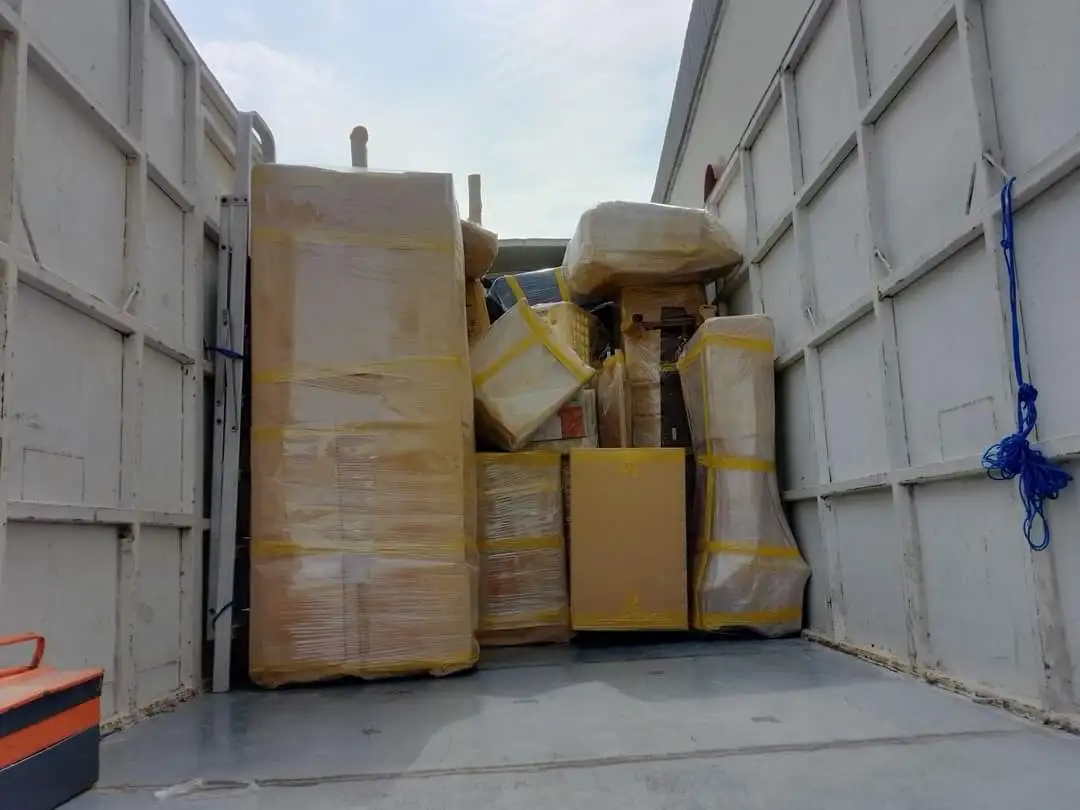
Riyadh to Dubai is one of the biggest intra-GCC moving corridors right now. Regional HQs relocating, families reshuffling, Aramco contractors rotating into Dubai-based postings. The GCC customs union makes this move mechanically simpler than most international relocations — but simpler doesn't mean obvious, and we've seen plenty of families stuck at Al Ghuwaifat for three hours because one form was missing.
Here's what the Saudi-to-Dubai move actually looks like, from the shipping decision to the school-year timing.
Truck or Sea Freight?
The GCC customs union means your household goods move under a single customs framework between Saudi and the UAE. That opens up an overland option most intercontinental moves don't have.
- Overland truck (Riyadh → Dubai): 12 to 18 hours driving, 36 to 72 hours door-to-door. Border crossing at Al Ghuwaifat (Abu Dhabi side) is the most common route; Al Batha works if you're in the Eastern Province. Cost: AED 12,000 to AED 28,000 for a 3-bed family household.
- Sea freight (Jeddah/Dammam → Jebel Ali): 10 to 21 days door-to-door. Cost: AED 18,000 to AED 40,000 for the same volume. Makes sense if you're in the Red Sea port cities.
- Air freight: 3 to 5 days but prohibitively expensive — AED 70,000+ for a household. Only used for documents and urgent items.
For most Riyadh-based families, overland truck wins on both cost and speed. For Jeddah, sea freight is usually cheaper than trucking across the peninsula.
Customs: Easier Than You Think, With Caveats
The GCC Common Customs Law treats Saudi-origin goods moving to the UAE as effectively intra-union. No duties on used household goods you've owned for more than 6 months. VAT that was already paid in Saudi (15%) is not charged again in the UAE (5%) on personal-use items.
What you cannot ship:
- Alcohol: prohibited for export from Saudi Arabia entirely. Don't pack it. Don't hide it. The penalty is severe on the Saudi side and the UAE customs officers will check a random box or two.
- Certain medications: items that are prescription-only in the UAE require a doctor's letter and sometimes MoH pre-approval. Common painkillers with codeine are restricted.
- Satellite receivers with certain cards, and VoIP equipment may be flagged. Not typically a problem for household items but worth noting.
- Anything looking commercial (new-in-box electronics, more than one of anything): customs can reclassify as import and charge duties.
For the full UAE-side customs workflow, see our household goods customs guide and the specific list of prohibited items for Dubai customs.
Visa Reality — GCC vs Non-GCC Nationals
This trips up a lot of expats. Your status in Saudi Arabia determines what you do before you land in Dubai:
- If you're a GCC national (Saudi, Kuwaiti, Bahraini, Qatari, Omani): you enter the UAE visa-free and can live/work with residence card paperwork done locally.
- If you're a non-GCC national on a Saudi iqama (Indian, Filipino, British, American, etc. living in Saudi): you cannot cross on your iqama. You need a UAE entry permit — typically an employment visa or a visit visa — issued before you travel.
- Your dependents' visas have to be processed separately. Don't assume your company's PRO handles spouses and children automatically.
Budget 2 to 6 weeks for UAE visa processing before you can physically relocate.
Tax Residency: The First-Year Math
UAE tax residency is a real thing since the Cabinet Decision No. 85 of 2022 came into force. Saudi Arabia has its own zakat and tax frameworks. If you move mid-year, you can end up claimed by both jurisdictions for part of the year — or by neither, which is worse for unlocking double-taxation treaty benefits.
The quick math:
- UAE grants tax residency if you're physically present 183 days in a calendar year, or 90 days with a UAE home plus employment/income
- Saudi treats you as resident if you spend 183+ days there, or have a permanent home there used regularly
- Move before 1 July and you can reach the 183-day threshold in the UAE easily; move after October and you're stuck waiting for year 2
We've put together a detailed breakdown in our UAE tax residency timing guide — worth reading before you pick a move date if income tax compliance matters for your situation.
The Car Question
Saudi-spec GCC cars transfer to UAE registration cleanly — that's one of the best things about this corridor. The process:
- Obtain a Saudi-side export clearance from the ISTIMARA office
- Drive or ship the car to the UAE (overland is simplest)
- UAE customs clearance at the border — 5% VAT does not apply on personal-use vehicles you've owned more than 1 year
- RTA inspection (Dubai) or equivalent emirate inspection
- Transfer registration to a UAE plate — typical cost AED 800 to AED 1,500 including plates
Non-GCC-spec cars (American-spec, Japanese domestic market imports) can still be registered but face GSO compliance checks. Budget more time.
School-Year Timing
The UAE school year starts Monday 31 August in the upcoming intake, per the Ministry of Education calendar. Saudi schools typically end their year in late June. That gives you a tight window — roughly 8 to 10 weeks — for families with school-age children to complete the physical move, school admission, medicals, and uniform fittings.
Our recommendation: ship household goods in May or early June, land the family in Dubai by late July, finalise school admissions in August. For the detailed back-to-school timing playbook, see our back-to-school moving guide. For general first-time UAE orientation, the Dubai expat guide covers DEWA, Ejari, and the first-month checklist.
Hidden Costs
Most Saudi families underestimate these:
- Bridge accommodation: 2 to 6 weeks in a serviced apartment while the new place is set up — AED 8,000 to AED 30,000
- School admission deposits: AED 3,000 to AED 10,000 per child, non-refundable if you don't enrol
- Initial DEWA + chiller + Ejari: AED 4,500 to AED 8,500 in one week
- First-year housing (4 cheques): expect to pay the first cheque upfront as security
Our hidden-costs guide goes deeper on the fees nobody quotes in advance.
What SAMA Movers Handles
We coordinate with Saudi-side packers for the origin pickup, manage UAE-side customs clearance and Jebel Ali or land-border clearance, and handle the last-mile delivery, unpacking, and setup in Dubai. Our villa moving and apartment moving teams handle the Dubai destination services regardless of which origin mover packed your goods.
Ready to plan the move? Request an estimate and we'll help you time the shipping leg around the school year and tax calendar.
Frequently Asked Questions
How long does a Saudi to Dubai household move take?
Overland truck from Riyadh to Dubai runs 36 to 72 hours door-to-door once loaded. Sea freight from Jeddah or Dammam to Jebel Ali takes 10 to 21 days. Add 3 to 7 days for UAE customs clearance and last-mile delivery. Plan 2 to 4 weeks from origin pickup to final setup in your Dubai home.
Can I drive my Saudi car to Dubai and register it there?
Yes. GCC-spec cars transfer cleanly under the customs union. You'll need the Saudi export clearance, UAE customs entry, RTA inspection, and registration with UAE plates. Budget AED 800 to AED 1,500 in fees plus insurance. Cars owned less than one year may be treated as imports subject to 5% VAT — keep your original registration.
Do Saudi-bought appliances work on UAE electricity?
Yes. Both countries run 230V at 50Hz with similar plug standards (BS-1363 three-pin in the UAE, various in Saudi). Most appliances work without adjustment. A few Saudi-spec air conditioners and water heaters are tuned for the different climate and may perform differently in Dubai's humidity — not a safety issue, just efficiency.
What cannot be shipped from Saudi Arabia to the UAE?
Alcohol is the main one — it's prohibited for export from Saudi. Certain prescription medications, satellite receivers, VoIP equipment, and any quantity that looks commercial (multiple new-in-box items) can also be held up. When in doubt, declare it. Undeclared restricted items create delays that cost more than any fine.