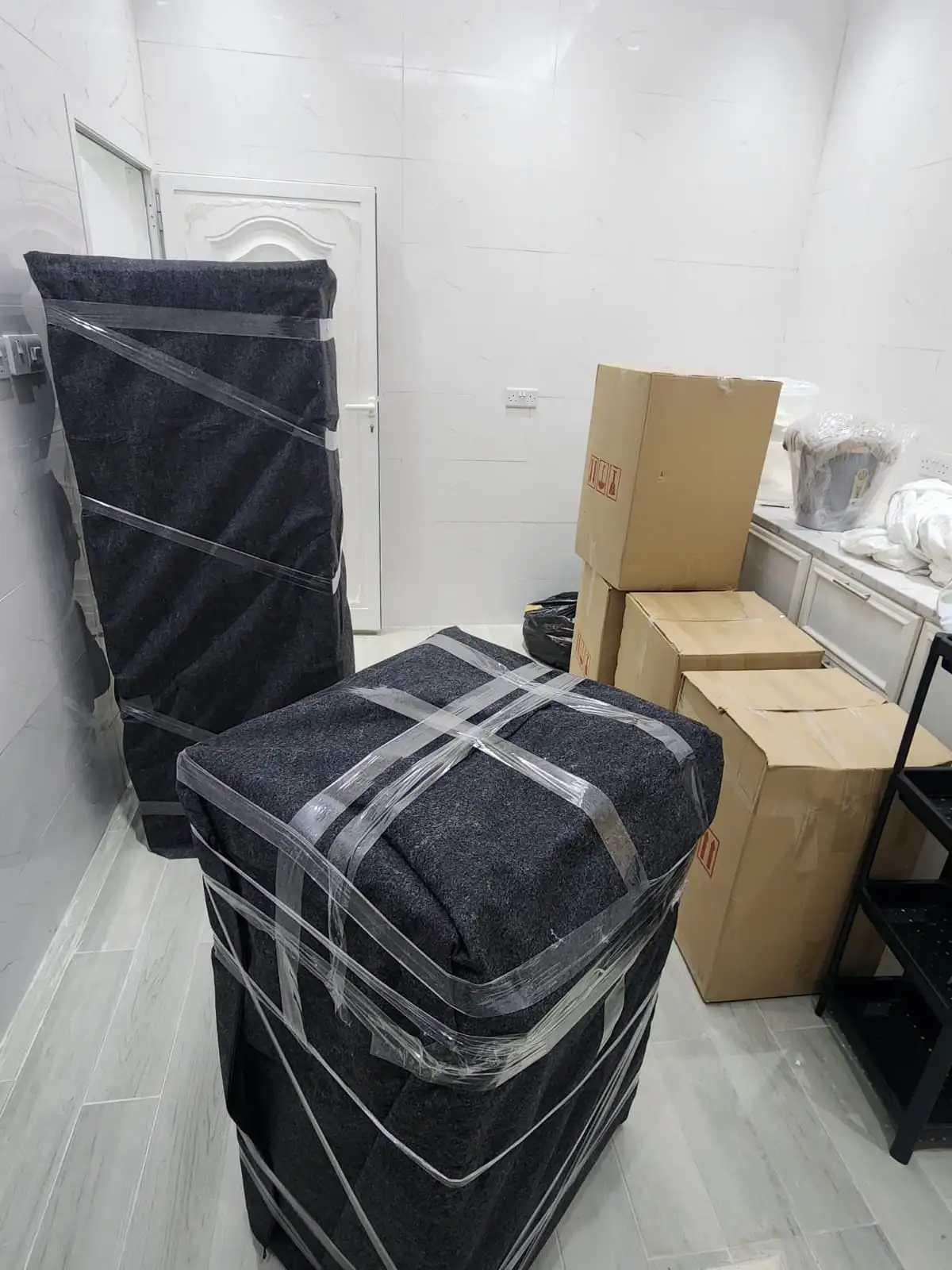
The first time we relocated a 14-rack server room — a fintech in DIFC moving two floors up in the same building — the client's IT lead arrived at 10pm Friday with a backup tape, a thermal camera, and a roll of pink masking tape. He labelled every cable port. Photographed every back panel. By Saturday 4am we'd unmounted, transit-padded, and re-racked all 14 cabinets in the new room. Production cutover happened at 6am. Trading desks opened on Monday with no incidents.
That's a properly scoped server-room move. Here's what most quotes get wrong, and what an honest Dubai IT relocation actually involves.
Why "Move The Server Room" Isn't One Job
It's at least four. Done in sequence, by different specialists, with overlapping windows.
Discovery and inventory: every server, switch, storage shelf, UPS, PDU, KVM, and patch panel — by serial number, rack-unit position, and cable count. The IT team owns this; we ask for it as a precondition. Without it, the rest is guesswork. Plan 1-2 days for a 5-15 rack environment.
Pre-move backup and snapshot: production data backed up to an off-site target. The IT team owns this too. We won't lift a single rack until backup completion is confirmed in writing.
Physical relocation: this is our part. Includes powering down in the right sequence, racking decisions (move racks fully populated vs unrack and individually transit-pack), the actual transport, re-rack at destination, and cabling reinstall to the documented map.
Cutover and validation: powering up in correct sequence, validating each service, monitoring for 24-48 hours. IT-led with mover support standing by for physical issues (loose connector, damaged port).
Mounted vs Unracked: The Real Decision
The default vendor instinct is "transport the racks fully populated" because it saves rack-level disassembly time. That's right for short, smooth-floor, same-building moves. It's wrong for almost everything else.
For an inter-building Dubai office move — say DIFC to ICD Brookfield, or DMCC to JLT Cluster T — we recommend unracking. Vibration on Sheikh Zayed Road and the loading-dock-to-truck transition is enough to loosen rail-mounted server screws on the heavier 4U+ chassis. Hard drives, especially older spinning disks, don't love truck transit while powered-down-and-mounted at full weight load.
For an in-building move (different floor, same building, same building's lift), we'll move racks mounted — wrapped in stretch film and rolled on heavy-duty platform dollies. The lift constraint is real: most Dubai office buildings have service lifts rated 1,500-2,500 kg, and a fully-populated 42U cabinet runs 600-900 kg easily. Two cabinets at a time is the practical maximum.
Dubai Pricing — The Tier Reality
From the actual jobs we've quoted in the past 12 months:
Small office IT relocation (1-3 racks, ~15 workstations, no production database): AED 3,000 to 6,000. Same-building or short-hop move, weeknight or single-weekend window. This is the SME shell-and-core moving into a fitted-out DMCC unit.
Medium business networks with a full server room (5-12 racks, mid-sized fintech or enterprise SaaS): AED 8,000 to 20,000. Two-night weekend window typical. Includes our crew, IT-grade transit packaging, and a return visit for any post-cutover physical issues.
Large enterprise IT and data-centre moves (15+ racks, hot-aisle / cold-aisle layouts, on-prem regulated workloads): AED 25,000 and up. Multi-weekend phased approach. Banks and regulated entities almost always insist on phased migration — see our DIFC shell-and-core walkthrough for the broader regulated-tenant context.
These exclude IT-team labour, license-transfer fees, and any new cabling at the destination. We can recommend Dubai-licensed structured-cabling teams; we don't terminate fibre or copper ourselves because mixing physical-move and IT scope creates accountability problems when something doesn't work on Monday.
The DIFC Friday-Night Window — And Why It Actually Works
Dubai's business week runs Monday-Friday now, which means the genuine production-quiet window starts Friday at 6pm and ends Sunday at 9pm. That's 51 hours.
For most server-room moves, you don't need the whole 51 — you need the 18-24-hour low-traffic core. We typically schedule:
- Friday 6pm: discovery review, final backup confirmation, system shutdown sequence begins
- Friday 9pm to Saturday 4am: physical move and re-rack
- Saturday 4am to Saturday noon: cabling, IT validation, rolling power-up
- Saturday noon onward: client IT runs validation tests; we stand by
- Sunday: production-load testing, monitoring, contingency hours
Friday-night kickoff trips up first-time clients because they assume "weekend = Saturday morning." In Dubai, Saturday morning is too late if cutover needs to be safe before Monday markets open at 8:00 GST.
What Goes Wrong, And How To Quote For It
Cabling that doesn't match the documentation. We've opened racks where the back panel looked like a plate of spaghetti someone had given up on. The IT team's documentation said port 23 was the SAN uplink; in reality it was 24, and 23 was the failover that hadn't been tested in two years. Fix: photograph everything yourself before the IT team's documentation pass. Compare the two before powerdown.
UPS units that are heavier than the floor rating. Double-conversion online UPS systems on a 12U or 18U format can run 200+ kg dense. Older Dubai office buildings — Bur Dubai commercial towers from the early 2000s — have raised-floor ratings that struggle with point loads above 750 kg/m². Confirm before scheduling.
Loading bay restrictions. DIFC towers, ICD Brookfield, Index Tower, the Boulevard towers — most have specific loading-bay slots and a vehicle-entry permit that needs 48 hours' notice. We bake that into our preparation; not every IT-side vendor remembers.
Sharp temperature drops at the new room. If the destination room hasn't been at server-spec temperature for at least 24 hours pre-move, condensation is a real risk. We've had clients flip the AC on Friday afternoon for a Saturday-morning move and then wonder why a switch threw moisture errors. Pre-cool the room minimum 48 hours.
Insurance and Risk Allocation
Risk on a server-room move is a conversation to have before anything is powered down, and it is one the client should lead. No cover of any kind on the physical move extends to data loss, business-interruption costs, or downstream regulatory penalties from a missed RTO. For server-room moves, we recommend the client carries an IT-relocation rider on their existing professional liability or business-interruption policy. Premium for a one-off move is typically 0.4-0.8% of declared equipment value; the rider also pays out if validation testing fails.
Arrange that rider through your own broker with the declared equipment value agreed in writing, and do it before the contract is signed, not after. What we bring to the physical side is anti-static transit packing, foam-lined crating for individual chassis, air-ride suspension on the truck, and a serial-numbered inventory photographed at both ends.
Frequently Asked Questions
How long does a server room relocation actually take in Dubai?
For a 5-12 rack environment, the physical move portion takes 6-10 hours of a typical Friday-night to Saturday-morning window. End-to-end including discovery, backup, cutover, and validation runs 4-7 days of project time. Same-building moves can compress to a single overnight; cross-building moves benefit from a full weekend.
Can servers be moved while still mounted in their racks?
Sometimes — for short, smooth-floor, same-building moves with reinforced platform dollies. For inter-building Dubai moves involving truck transit and Sheikh Zayed Road vibration, we recommend unracking and individually transit-packing servers. The decision depends on equipment age, drive type (spinning vs SSD), rack weight, and route quality.
What does an IT relocation cost for a Dubai office?
Small offices with 1-3 racks run AED 3,000-6,000. Mid-sized server rooms with 5-12 racks land between AED 8,000 and AED 20,000. Genuine data-centre relocations with 15+ racks start at AED 25,000 and scale with rack count, regulated-tenant requirements, and phased-migration complexity. Quotes that come in below those ranges almost always exclude proper transit crating, after-hours premium, or post-cutover support.
Do I need to back up before the move?
Yes — a verified, off-site backup is a non-negotiable precondition. Reputable movers will not power down a single rack until the IT team confirms backup completion in writing. Backup also covers worst-case scenarios like a dropped chassis or a cable port that fails post-cutover.
Planning an office relocation that includes a server room? Start with our office moving service, or talk to our IT-relocation lead for a properly scoped weekend-window plan.